Breadfruit — known botanically as Artocarpus altilis — is a large, round, starchy fruit that grows on tall tropical trees across Jamaica and the wider Caribbean. When roasted, the flesh turns soft, buttery and slightly nutty, with a flavour and texture often compared to freshly baked bread or roasted potato. That comparison is where the name comes from.
Roasted breadfruit is one of Jamaica's most iconic side dishes — traditionally cooked whole over an open fire or charcoal grill until the skin is charred and the inside is tender. It is served alongside ackee and saltfish, escovitch fish, callaloo, or simply with butter and salt for breakfast.
Cooking Instructions
- Choose a "fit" breadfruit — fully grown but still firm, with skin just beginning to yellow
- Wash the breadfruit thoroughly and pat dry
- Cut a small X into the bottom to let steam escape during roasting
- Roast whole using one of three methods: in the oven at 200°C, on a gas hob burner, or over a charcoal grill
- Cook for 60–90 minutes, turning every 15–20 minutes for even charring, until the skin is blackened and a knife slides easily into the flesh
- Cool for 10–15 minutes until handleable
- Peel off the charred skin and remove the central core (the "heart")
- Slice into wedges or "pegs"
- Serve plain with butter and salt, or as a side to saltfish, ackee, callaloo, escovitch fish, or curry goat
Breadfruit was brought to Jamaica from Tahiti in 1793 by Captain William Bligh — the same Captain Bligh of the HMS Bounty mutiny — on a return voyage commissioned to provide cheap, filling food for the enslaved population on Jamaican plantations. The first attempts were unpopular; for many years the fruit was fed to livestock rather than eaten. Over time, though, breadfruit took root in Jamaican cooking and is now one of the most recognisable starches on the island. The original tree Bligh planted at the Bath Botanical Gardens in St Thomas reportedly still bears fruit today.
Choosing the right breadfruit matters more than the method. A dark green, hard breadfruit is unripe and better boiled. A very soft, fully ripe one is best baked or mashed into a dessert. For roasting, you want the in-between stage — what Jamaican cooks call "fit" — firm to the touch but with the skin starting to yellow at the seams. This is when the inside roasts to that signature soft, bread-like texture.
This recipe uses fresh breadfruit from our vegetables and yams range. We typically sell breadfruit in halves, which is enough for two to three people and roasts in around 45–60 minutes rather than the full 90.
INGREDIENTS
Serves 4 as a side, or 2–3 as a main with saltfish or ackee.
- 1 whole fresh breadfruit (or 2 halves), at "fit" stage — firm but mature
- Butter, to serve
- Salt, to taste
- Optional, for the fried finish: 2–3 tablespoons vegetable oil
COOKING INSTRUCTIONS
Three methods — oven, gas hob, or charcoal grill. The oven is easiest for UK kitchens; the gas hob and charcoal methods give the more authentic smoky flavour.
Preparation (all methods)
- Wash the breadfruit under cold running water and pat dry.
- If you have a whole breadfruit, use a sharp knife to cut a small X-shaped slash into the bottom (opposite the stem). This lets steam escape during roasting and stops the fruit from bursting.
- If you have halves, you can skip the X cut — the steam has somewhere to go already.
Method 1: Oven (easiest)
- Preheat the oven to 200°C / 180°C fan / Gas 6.
- Line a baking tray with foil for easy cleanup.
- Place the breadfruit on the tray. For a whole one, sit it upright on its base. For halves, place cut-side down.
- Roast for 60–90 minutes (or 45–60 minutes for halves), turning the breadfruit every 20 minutes. The skin will turn dark brown and char in places — this is correct.
- It's ready when the skin is blackened all over and a sharp knife slides easily into the flesh with no resistance.
Method 2: Gas hob (more traditional)
- Place the breadfruit stem-side down directly onto a gas burner over a medium flame.
- Roast for 10 minutes, then turn onto its next side.
- Continue turning every 5 minutes until every side has charred — about 45–60 minutes total.
- The top and bottom take the longest because they contain the most sap (or "stain") — finish with 10 minutes on the bottom to make sure the inside is fully cooked.
- Use tongs and wear oven gloves — the breadfruit gets very hot and the skin will be blackened.
Method 3: Charcoal grill (most authentic)
- Get a charcoal grill or barbecue to a steady medium heat, with coals glowing.
- Place the breadfruit directly onto the coals or on the grill grate.
- Roast for 60–90 minutes, turning every 15 minutes for even cooking.
- The skin will char and blacken — the smoke gives the flesh the deep, traditional flavour.
- Test with a sharp knife — when it slides in easily, the breadfruit is done.
After roasting (all methods)
- Remove from the heat and let the breadfruit cool for 10–15 minutes until you can handle it.
- Peel or scrape off the charred black skin with a knife — it should come away cleanly.
- Cut the breadfruit in half lengthways, then quarters. Remove the central core (the soft "heart" with the stem inside) — this part is not eaten.
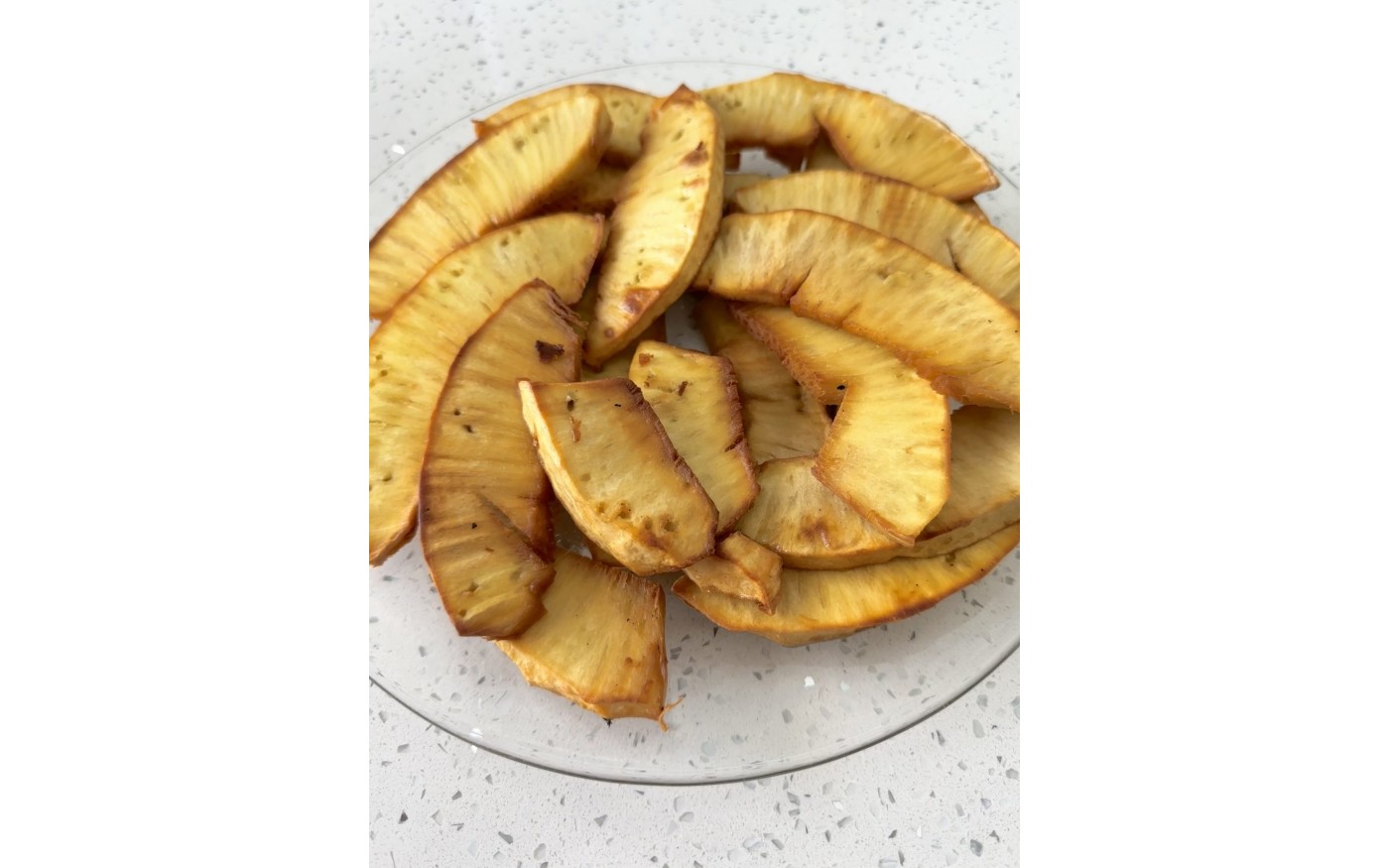
- Slice the flesh into wedges or "pegs" about 1 cm thick.
- Serve immediately with butter and salt, or move on to the optional fried finish below.
Optional: fried finish
- Heat 2–3 tablespoons of vegetable oil in a frying pan over a medium-high heat.
- Fry the breadfruit pegs for 2–3 minutes each side until golden and crispy.
- Drain on kitchen paper and season with a pinch of salt.
- This gives you the best of both worlds — soft and creamy inside, golden and crisp outside. It is also a popular way to use leftover roasted breadfruit the next day.
SERVING SUGGESTIONS
Roasted breadfruit is one of Jamaica's most versatile sides. Traditional pairings include:
- Ackee and saltfish — the classic Jamaican breakfast plate. Roasted breadfruit, ackee and saltfish is a Sunday morning staple across the island. See our Jamaican Ackee & Saltfish Recipe.
- Saltfish on its own — soaked, flaked and sautéed with onion, scotch bonnet and tomato. Pairs naturally with breadfruit pegs. Find saltfish in our salted fish range.
- Escovitch fish — fried fish topped with pickled vegetables and scotch bonnet, served with breadfruit on the side.
- Callaloo — sautéed Caribbean greens, often eaten with breadfruit at breakfast or as a light supper.
- Curry goat, oxtail or stewed chicken — breadfruit makes a hearty alternative to rice or hard food alongside slow-cooked Jamaican dishes.
- Plain, with butter and salt — the simplest and arguably the best way to enjoy a freshly roasted breadfruit.
WHAT IS BREADFRUIT?
Breadfruit (Artocarpus altilis) is a large, round, starchy fruit that grows on tall tropical trees native to the South Pacific. A single tree can produce 200 fruits a year, with each fruit weighing 2 to 5 kilograms. Although it is botanically a fruit, breadfruit is eaten and cooked like a vegetable — closer in use to a potato or yam than to anything sweet.
The name comes from the texture of the cooked flesh, which is soft, dense and slightly sweet — strikingly similar to freshly baked bread. Unroasted, breadfruit is firm, pale green and inedible. The transformation that happens during roasting is what makes it such a beloved staple across the Caribbean.
Breadfruit arrived in Jamaica through one of the most famous voyages in maritime history. In 1787, Captain William Bligh was commissioned by the British Crown to sail to Tahiti, collect breadfruit saplings, and transport them to the Caribbean as a cheap and filling food source for the enslaved population on the sugar plantations. The first voyage ended in the infamous mutiny on board HMS Bounty in 1789. Bligh returned to the Pacific on a second voyage in 1791 and successfully delivered the breadfruit to Jamaica in February 1793. The original trees were planted at the Bath Botanical Gardens in St Thomas, where descendants reportedly still grow today.
Although initially rejected by Jamaicans — who fed it to their livestock for years before adopting it themselves — breadfruit eventually became one of the most recognisable starches in Jamaican cuisine. It is now eaten roasted, fried, boiled, mashed, made into chips, ground into flour, and used as a thickener for soups and stews. Nutritionally, breadfruit is naturally gluten-free, rich in complex carbohydrates, high in fibre, and a good source of vitamin C, potassium and magnesium.
Across the Caribbean and Pacific it is also known as fruta pan (Spanish), fruit à pain (French Caribbean), ulu (Hawaiian) and 'uru (Tahitian).
Browse our full range of Jamaican food online with UK-wide delivery, or read our Jamaican Cho Cho & Saltfish Recipe for another traditional Jamaican breakfast plate.